LULU — priced for collapse, built like a compounder

LULU — priced for collapse, built like a compounder

lululemon athletica inc. (NASDAQ: LULU) clears all three hard screening criteria — ROE of 29–42% in FY2023–FY2025, $1.28B in trailing free cash flow (9.29% yield), and a trailing P/E of 9.79× that sits 71% below its own five-year average and 54% below the peer-group median. The stock is at an eight-year low after a Q1 FY2026 guidance cut and downgrade cascade; Michael Burry has 26% of his portfolio in this thesis. Full bull/bear framework included.

US Stock Pick: 3-Year ROE > 15%
2026/6/10 · 21:25
1 订阅 · 23 内容
Current price: $121.36 (June 9, 2026 close) · Market cap: ~$13.8B · Sector: Consumer Non-Durables / Apparel 1
lululemon athletica inc. (NASDAQ: LULU) clears all three hard screening criteria — ROE above 15% every year for three consecutive fiscal years, consistently positive free cash flow, and a valuation that is deeply compressed relative to both its own history and sector peers. The tension here is starker than most profiles: the business is financially elite (32% ROE, 55.7% gross margins, $1.28B in trailing free cash flow) while the stock sits at an eight-year low after a guidance cut that sent a chorus of analysts to the sidelines. That gap between business quality and share price is the entire investment proposition — and the entire risk.
On June 4, 2026, lululemon reported Q1 FY2026 earnings and simultaneously slashed its full-year guidance. The stock fell 11% in after-hours trading, and on June 5 a wave of downgrades brought the Buy rating count to just one out of 33 analysts — the fewest since the company's 2007 IPO. 2 Then on June 7, Michael Burry — who called the 2008 housing crash — publicly increased his stake and wrote that LULU's "relative value outweighs Microsoft." 3 One analyst at BNP Paribas Exane has an $88 price target. Burry has a 26% portfolio concentration. Rarely do you see the distribution of conviction this wide.

What lululemon does

lululemon athletica inc. was founded in Vancouver, Canada in 1998 by Dennis Wilson as a premium yoga-apparel brand. It has since grown into one of the highest-margin specialty retailers in the world — with roughly 770 stores globally, approximately 39,000 employees, and TTM revenue of $11.2B. 1
The business model rests on three interlocking elements: proprietary technical fabrics (Luon, Nulu, Everlux — marketed under the "Science of Feel" umbrella), community-led retail (roughly 2,000 global brand ambassadors, local fitness partnerships, in-store events), and direct-to-consumer distribution (owned stores plus e-commerce, with e-commerce representing about 42% of revenue). The company does not wholesale through department stores, which keeps brand perception and margin structurally elevated. Gross margins have averaged above 55% for several years — well above Nike's (NKE) ~44% gross margin — reflecting both premium pricing power and DTC channel mix.
Revenue is split roughly 65% Americas, 35% international. The international segment (primarily China mainland, Europe, and Rest of World) has been the growth engine: international revenue grew 22% in Q1 FY2026 while the Americas contracted. 4

ROE track record

All three hard-criteria years clear 15% by a wide margin. The methodology note matters here: StockAnalysis uses average shareholders' equity (which produces a modestly higher number when equity is growing), while the SEC EDGAR XBRL figures use period-end equity. Both methods confirm the same directional picture. 5 6
Fiscal yearRevenueNet incomeROE (StockAnalysis)ROE (SEC EDGAR)
FY2023 (ended Jan 2023)$8.11B$855M29.03%27.1%
FY2024 (ended Jan 2024)$9.62B$1,550M42.01%36.6%
FY2025 (ended Feb 2025)$10.59B$1,815M42.42%42.0%
FY2026 (ended Feb 2026)$11.10B$1,579M34.01%31.8%
TTM (ended May 2026)$11.20B$1,460M31.30%
The ROE trajectory tells a complete story in one read. The peak years (FY2024–FY2025, 42%) were driven by exceptional operating leverage as lululemon scaled rapidly with a lean balance sheet. The current level (31.30% TTM) reflects margin compression from tariffs and slower North American growth — but is still roughly double the channel's 15% floor. 5

Free cash flow

正在加载图表…
PeriodOperating cash flowCapExFCFFCF yield
FY2023 (ended Jan 2023)$561M$228M$328M
FY2024 (ended Jan 2024)$1,896M$252M$1,644M
FY2025 (ended Feb 2025)$1,897M$314M$1,583M
FY2026 (ended Feb 2026)$1,483M$561M$922M
TTM (ended May 2026)$1,940M$656M$1,280M9.29%
SEC EDGAR XBRL and StockAnalysis FCF figures match exactly across all periods. 6 7
The FY2023 figure ($328M) looks anomalously low relative to adjacent years. It reflects a temporary working capital build during that year's rapid inventory expansion, not a structural deterioration. FCF rebounded sharply in FY2024 ($1.64B) and has remained positive throughout. At the TTM level, lululemon generates $1.28B in free cash flow on a market cap of roughly $13.8B — a 9.29% yield. P/FCF is 10.77×, the lowest in the company's recent history. 1
lululemon does not pay a dividend. The company instead returns capital through buybacks: the board has a $1.6B authorization outstanding, and in Q1 FY2026 alone the company repurchased 2.2 million shares for approximately $430M. 8 Buyback yield on the TTM basis is 3.94%. 1

Valuation: extreme compression across every metric

正在加载统计卡片…
Metrics as of June 9, 2026 close. 1
Against lululemon's own five-year history. The valuation compression since FY2021 is not a gradual drift — it is a repricing event. 5
MultipleCurrentFY2021–FY2025 avgDiscount to own history
Trailing P/E9.79×33.45×−70.7%
P/B2.88×11.13×−74.1%
EV/EBITDA5.61×18.96×−70.4%
A 70%+ compression on all three multiples simultaneously is unusual. For context: lululemon's P/E was above 40× as recently as FY2022. The current 9.79× is lower than The Gap (GPS) at 8.61×, a mature value retailer showing little growth.
Against sector peers. LULU is the cheapest profitable name in the peer group on trailing P/E and EV/EBITDA, while delivering the second-highest net margin and one of the highest ROEs among profitable peers. 9 10 11
TickerTrailing P/EForward P/EP/BEV/EBITDANet marginROE
LULU9.79×10.88×2.88×5.61×13.03%32.03%
GPS (Gap)8.61×8.93×2.14×6.07×6.25%27.58%
DECK (Deckers)16.02×15.04×6.30×10.52×18.71%40.86%
NKE (Nike)29.44×27.34×4.69×17.92×4.84%16.02%
ONON (On Holding)40.98×21.01×5.74×20.70×8.02%15.50%
BURL (Burlington)33.38×26.84×10.99×19.73×5.24%39.14%
ADDYY (Adidas)21.11×16.77×4.63×11.19×5.52%22.92%
Peer median21.11×16.77×4.63×11.19×
LULU vs. median−53.6%−35.1%−37.8%−49.9%
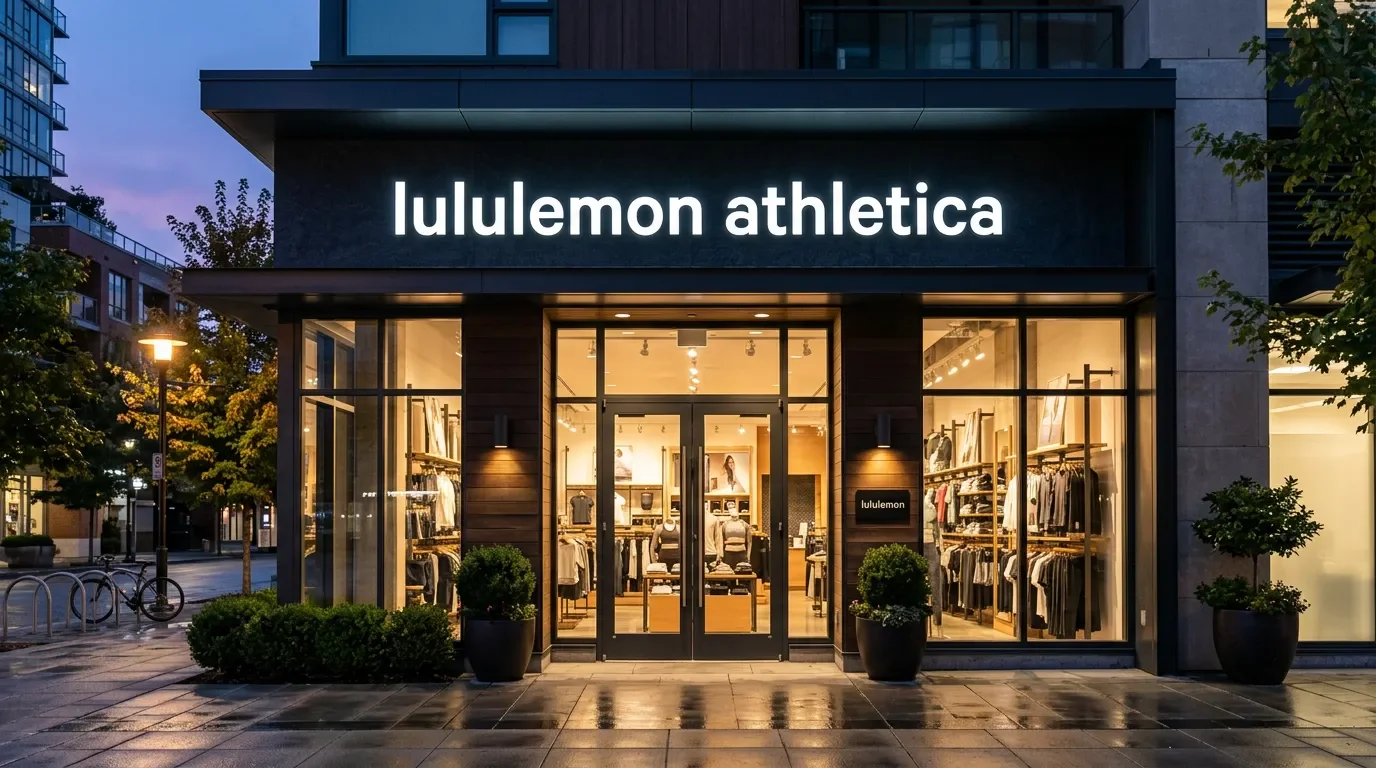
Lululemon storefront with branded signage after guidance cut
Lululemon store banner, June 2026 — stock hit an eight-year low on June 5 after a cascade of analyst downgrades. 2
The nearest analogue in the peer table is GPS (8.61× trailing P/E), a company with slower revenue growth, lower margins, and no meaningful product IP. LULU trading at parity with GPS is the valuation paradox at the core of this profile.

Revenue and earnings trend

Revenue growth has decelerated sharply every year for five consecutive years, and FY2026 Q2 guidance implies the first outright quarterly revenue decline since COVID. 12
PeriodRevenueYoY growthNet incomeOperating marginNet margin
FY2022 (ended Jan 2022)$6.26B+42.0%$623M17.1%9.9%
FY2023 (ended Jan 2023)$8.11B+29.6%$855M16.4%10.5%
FY2024 (ended Jan 2024)$9.62B+18.6%$1,550M22.2%16.1%
FY2025 (ended Feb 2025)$10.59B+10.1%$1,815M23.7%17.1%
FY2026 (ended Feb 2026)$11.10B+4.9%$1,579M19.9%14.2%
TTM (ended May 2026)$11.20B+4.2%$1,460M18.3%13.0%
Q1 FY2026 (ended May 3, 2026)$2.47B+4.0%$195M7.9%
The operating margin peaked at 23.7% in FY2025 (ended Feb 2025) and has been contracting since, falling to 18.3% on a TTM basis. The compression comes from two sources: tariff headwinds (management sized the FY2026 operating income impact at approximately $210M) and the increased discounting required to clear inventory in a weakening North American market. 13
Q1 FY2026's gross margin dropped to 54.2%, down 410 basis points from 58.3% a year earlier — tariffs accounted for 280 basis points of that decline. 4 Americas comparable-store sales fell 5% for the fifth consecutive quarter. Internationally, the story is the opposite: China mainland comparable sales grew 30% in Q1, and total international revenue rose 22%. 8
The revised full-year FY2026 guidance is revenue of $11.0B–$11.15B (down from the prior $11.35B–$11.50B) and EPS of $10.95–$11.15 (down from $12.10–$12.30). Q2 FY2026 guidance of $2.45B–$2.48B revenue — versus a consensus of $2.59B — is the first quarter that would show a year-on-year revenue decline since the pandemic. 4
Interim Co-CEO Meghan Frank attributed the shortfall to "spikes of negative commentary in the media and on social channels with regard to our brand, which had an impact on traffic and overall top line performance." She added: "These stories have died down and subsided. But we have not yet seen a return to our pre-disruption trends." 4

Balance sheet health

lululemon's balance sheet is notably clean given the scale of its business. No public credit rating from S&P or Moody's has been identified — the company has not gone through a traditional bond-market rating process, which is uncommon but not alarming for a firm with debt/EBITDA below 1×. 14
MetricValueContext
Cash & equivalents$1,510M
Total debt$2,140M
Net debt$621MModest leverage; Debt/EBITDA 0.67×
Debt / equity0.44×
Current ratio2.23×Comfortable
Quick ratio0.94×Inventory is a meaningful working capital item
Altman Z-Score6.95Well above the 3.0 distress threshold
ROIC27.72%
Gross margin55.70%
The $400M revolving credit facility (signed October 2025, maturing December 2026) had zero drawn balance as of the most recent filing. 14 The company is carrying $621M in net debt — a departure from the net-cash position it held for most of its history — but the Altman Z-Score of 6.95 and Debt/EBITDA of 0.67× signal the balance sheet is nowhere near stressed.

Risk factors and red flags

Tariff exposure: $210M+ headwind baked into guidance. Approximately 40% of lululemon's merchandise is manufactured in Vietnam, which faces a 46% US tariff. Cambodia contributes roughly 15% of sourcing. Management sized the FY2026 operating income impact at approximately $210M, and this is already embedded in the revised guidance. The elimination of the de minimis import exemption (effective August 2025) compounded the hit, since lululemon previously routed a portion of US e-commerce through Canadian warehouses. An escalation in reciprocal tariffs could add a further $320M+ to the operating income headwind, according to third-party supply chain analysis. 13 lululemon is diversifying its supplier base across Southeast and South Asia and negotiating better supplier pricing, but supply chain transitions at this scale typically take 18–36 months to fully execute.
CEO transition and brand vacuum. Former CEO Calvin McDonald announced his departure in December 2025. Incoming CEO Heidi O'Neill — a Nike (NKE) veteran with 25+ years of experience in product creation, brand strategy, and global marketing — does not start until September 8, 2026. 15 In the interim, CFO Meghan Frank and CCO André Maestrini are serving as co-CEOs. BTIG analyst Janine Stichter wrote on June 5: "We do not believe the root of the challenges has been fully diagnosed and see the company as being in a holding pattern as we await the arrival of incoming CEO Heidi O'Neill in September." 2 BNP Paribas Exane's Laurent Vasilescu went further: "Now that the CEO transition path is set, fundamentals come back into view, and they are not good." 2
Founder conflict and brand reputation damage. A proxy fight launched by founder Chip Wilson in late 2025 generated months of negative media coverage and, per management's own account, measurably hurt consumer traffic. A settlement in May 2026 added two Wilson-nominated directors (Laura Gentile and Marc Maurer) to the board and established an 18-month standstill agreement. 15 The standstill reduces the immediate governance risk, but Wilson's public critique — that lululemon "has lost its cool" — has arguably planted doubt among its core consumer base in ways that persist independent of any corporate resolution.
Short interest and institutional rotation. Short interest is approximately 7.35% of float (7.23M shares, 2.07 days to cover per Finviz), up roughly 14% since April 30. 16 Institutional ownership is 79.82%, but 13F filings show a mild net selling trend (−2.06%) over the most recent quarter. The short interest level is elevated but not extreme — days-to-cover of roughly 2 days means a short squeeze is unlikely to be the catalyst for any recovery.
Active litigation on multiple fronts. lululemon faces at least five active class-action lawsuits: PFAS chemical exposure in Luon-fabric products, false advertising of its Silverescent anti-odor technology, fabric quality issues (pilling, sheerness), a pricing fraud suit alleging inflated "original" prices on sale items, and a securities fraud class action filed in August 2024 still active in Delaware. A partial settlement with Costco (Wholesale) over a trademark dispute was reached in March 2026. 17 None of the active lawsuits currently have disclosed settlement amounts.
Insider transactions: net buying, but mixed. Against the backdrop of the falling stock, Director Charles Bergh bought 6,090 shares at $164.20 in March 2026 (~$1M open-market purchase), and Interim Co-CEO André Maestrini bought 3,275 shares at $151.02 in April 2026 (~$495K). Small sells by Chief Brand Officer Nicole Neuburger (622 shares) are read as routine diversification. Discretionary cash purchases total roughly 9,365 shares against fewer than 2,500 shares sold over the past 90 days — net buying. 15 16 Insider ownership sits at approximately 7.83%–13.46% depending on the float calculation used.

Near-term catalysts and market context

No near-term earnings: Q2 FY2026 is roughly three months away. The next quarterly report (covering the period ending around August 3, 2026) will arrive in early September — close to Heidi O'Neill's first day as CEO. That timing means the next major corporate data point will arrive with new leadership in place, and it may include additional guidance revisions as O'Neill resets expectations. BofA analyst Lorraine Hutchinson warned that the new CEO "may cause further strategic changes and guidance reductions." 2
Analyst consensus: Hold, average target $127–$136. Of 33 analysts covering LULU, 1 has a Buy (CFRA's Zachary Warring), 30 have Hold, and 2 have Sell — the fewest Buy ratings since the 2007 IPO. The June 5 downgrade wave included: BTIG (Buy to Neutral, removed PT), BNP Paribas Exane (Neutral to Underperform, PT $88), Telsey Advisory (Market Perform maintained, PT $175 to $122), Wells Fargo (PT $150 to $110), Barclays (PT $161 to $113), and Piper Sandler (PT $130 to $110). Average target is approximately $127–$136, implying 5–12% upside from the June 9 close. 2
Michael Burry's contrarian conviction. On June 7, Burry posted on Substack that he had added to his position after the post-earnings selloff, buying shares in the "low-to-mid $110 range." His Scion Asset Management 13F shows LULU at 26.12% of the portfolio — roughly 100,000 shares valued at approximately $17.8M. Burry noted that lululemon's tangible book value per share has "doubled from $20/share to ~$40/share over the last 3+ years" and described the analyst consensus as "the least cheery I have seen for a company in this financial condition without significant legal or regulatory liabilities pending." He compared investor sentiment to GameStop in 2019, before that stock gained 614%+. 3
No dividend. Buybacks are the only return mechanism. The $1.6B remaining buyback authorization, against a market cap of ~$13.8B, represents about 11.6% of current float — potentially meaningful if deployed during continued weakness.
52-week context. At $121.36, LULU is 54.5% below its 52-week high of $266.95 and 10.9% above its 52-week low of $109.36. The stock is at levels last seen in mid-2018. YTD return is approximately −41.6%. 1
Upcoming events: Team Canada official outfitter for the Milano Cortina 2026 Winter Olympics/Paralympics (February 2026 — already executed) and a recently announced first NFL clothing partnership (all 32 teams). Neither is large enough to move the revenue needle, but both reinforce that the brand is executing expansion beyond its yoga/athletic-leisure core.

Competitive positioning and moat

lululemon holds approximately 12% of the global athletic apparel market and commands gross margins (55.7%) that no major publicly traded competitor matches. 18 The moat rests on three reinforcing pillars:
Fabric IP and product quality. The "Science of Feel" fabrics (Luon, Nulu, Everlux) are proprietary and create a tangible performance and comfort advantage that consumers will pay $90–$150 for leggings to access. Multiple active lawsuits allege the products don't live up to their claims — and the legal risk is real — but the sustained 55%+ gross margins suggest the willingness to pay at a premium has not materially eroded at the margin level. 17
Community-led retail model. The 2,000+ global brand ambassadors (local fitness instructors, athletes, community leaders) create organic marketing and brand stickiness that cannot easily be bought or replicated. Nike has the global distribution and marketing budget. Vuori (private, ~$4B valuation) and Alo Yoga have momentum in the influencer-driven segment. But lululemon's grassroots community infrastructure — 20M+ Membership program, in-store events, ambassador network — is a structural advantage built over 25 years.
DTC channel purity. Without wholesale exposure, lululemon avoids the brand dilution and margin compression that hit most apparel companies when department stores mark down product. E-commerce at 42% of revenue gives the company direct consumer data and direct pricing control. This structural choice explains why lululemon's net margin (13.03% TTM) exceeds Nike's (4.84%), Adidas's (5.52%), and every other peer except Deckers Outdoor.
The chief competitive risk is brand relevance. North American comparable sales have fallen for five consecutive quarters. Founder Wilson's public statements that the brand "has lost its cool" and is "stuck with customers who only follow generic athletic brands" — while potentially self-interested given his proxy fight — have become part of the mainstream consumer narrative. New entrants Vuori and Alo Yoga are capturing aspirational younger consumers who see lululemon as a brand their parents wear. The question Heidi O'Neill's tenure will answer: can lululemon win back premium cachet in North America while continuing to expand internationally?

Bull case / bear case

Bull case. The financial profile at the current price is extraordinary by any historical standard. A 31% ROE business generating $1.28B in annual free cash flow (9.29% yield) with 55.7% gross margins and $1.6B in buyback capacity, trading at 9.79× trailing earnings — 71% below its own five-year average P/E — requires either a permanent impairment of the business or a genuine re-rating opportunity. The bear argument (North America is saturating, competition is rising, tariffs are hurting) is all fully embedded in a stock that is down 54% from its peak. International revenue is growing at 22%. The new CEO brings a Nike-caliber brand-rebuilding track record. Michael Burry is willing to put 26% of his portfolio behind this thesis. If lululemon's Americas business stabilizes under O'Neill and the valuation reverts even halfway toward its 5-year average, the return from current levels would be substantial.
Bear case. A cheap stock is only a value if earnings don't keep falling. Q2 FY2026 guidance implies the first year-on-year revenue decline since COVID — and BNP Paribas Exane's Laurent Vasilescu argues the incoming CEO is "growth-oriented" rather than turnaround-focused, meaning estimates may face another reset when O'Neill arrives in September. The Americas comp sales trend (-5%, five quarters running) has not shown a credible inflection. Tariff headwinds are only partially mitigated. Short interest is rising. The multiple looks cheap at 9.79× — but if FY2027 EPS falls another 15–20%, the forward earnings base shrinks and the stock may not be as cheap as it appears on trailing figures. BNP Paribas's $88 target implies 27% further downside from here.
The key question the next two earnings reports will answer: does the Americas comparable-sales trend stabilize (signaling brand damage is recoverable), or does it deepen further toward a structural market-share loss? That distinction separates a re-rating opportunity from a value trap.

All financial data sourced from StockAnalysis, SEC EDGAR XBRL filings (CIK 0001397187), Finviz, CNBC, Yahoo Finance, Wall Street Journal, SGB Media, 24/7 Wall St., LawFold, and other sources as cited. Price data reflects the June 9, 2026 close at $121.36. This article is for informational and research purposes only and does not constitute investment advice or a recommendation to buy or sell any security. All data should be independently verified before making any investment decision.

围绕这条内容继续补充观点或上下文。

  • 登录后可发表评论。